


LIFESTYLE CREEP ISN'T ABOUT SPENDING MORE

Updated: May 8
❝Intentional living is the art of making our own choices before others' choices make us.❞ -Richie Norton
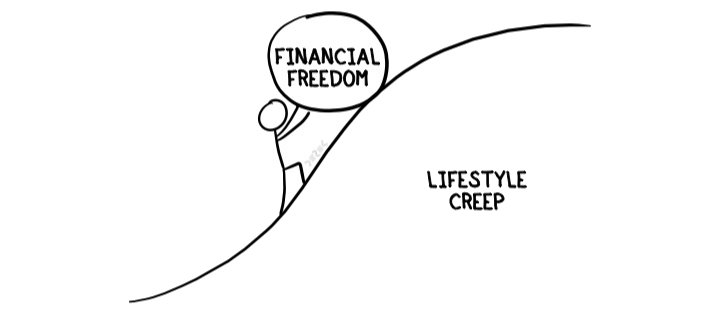
Lifestyle creep isn't about spending more; it's about spending without knowing why.
WHAT PEOPLE ACTUALLY WANT
Most people would agree with the statement: "My life would be better if I had a little more money."
But if they're honest with themselves, money isn't really the goal. What people want is a good life; some version of comfort, security, convenience, experiences, freedom, belonging. Sometimes status, though fewer people admit to that one.
Once we recognize that lifestyle is the real objective, something shifts. The question stops being "how much money do I make?" and starts being "how will I use that money to live well?"
The problem is that most people never actually ask themselves what kind of lifestyle they want. Instead, they let the answer get filled in from outside.
That's where lifestyle creep enters.
Want to watch instead?
WHAT LIFESTYLE CREEP IS
Most of us are working toward something like financial independence — the point where work becomes optional because we're self-sustaining. We get there by saving the difference between what we earn and what we spend.

Think of that gap, that savings, as freedom fuel. The more of it you accumulate, the closer you get to work being a choice rather than a requirement.

Over time, incomes tend to rise. If your lifestyle cost stays roughly flat, the gap widens. Saving gets easier. Financial independence gets closer.
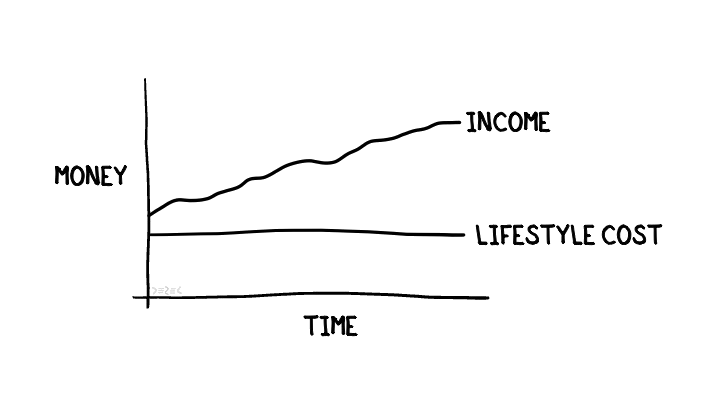
And as that gap grows, so does your savings... your freedom fuel.

But here's what often happens instead: as income rises, so does spending. Vacations get a little more ambitious. Restaurants get a little nicer. The car gets upgraded. Maybe the house does too. Each individual decision seems reasonable in isolation.
That's lifestyle creep. Not a single choice, but a slow drift. Lifestyle costs rise without awareness, quietly narrowing the gap between what you earn and what you keep.

WHY LIFESTYLE CREEP HAPPENS
Lifestyle creep isn't usually intentional. It happens because humans are wired to look outward for signals about how to live.
We know exactly how it feels to be us. We don't know how it feels to be anyone else. So we assume others have it better, that a slightly upgraded version of our life would feel better, too. The media reinforces this. Our social circles reinforce this. The Joneses, whoever they are in your world, reinforce this.

And we're good at justifying it. We earned this. We deserve it. Which may well be true, but "I earned it" isn't the same as "I chose it thoughtfully."

Because financial independence depends on both how much money you have and how much your lifestyle costs, being pulled unconsciously toward what others have is a slow tax on your future freedom.

|
 |
This questionnaire is an instrument that taps into ten valued domains of living. It assesses the perceived importance of each of these ten life domains and the degree to which you are living in accordance with this perceived importance. |
 |
|
LIFESTYLE CREEP VS. INTENTIONAL LIFESTYLE DESIGN
Here's where I want to push back against the pushback I sometimes hear.
When I talk about lifestyle creep, someone usually points out that increasing your lifestyle isn't inherently bad... that if you've worked hard and you're on track, spending more isn't something to feel guilty about. And they're right. That's not what I'm arguing.
Intentionally choosing a better lifestyle is not lifestyle creep. If you've looked at your trajectory, decided you're ahead, and chosen to spend more on things that actually matter to you, that's lifestyle design. That's the goal.
Lifestyle creep is something different. It's when your costs rise without a decision being made. When you look up one day and realize you're spending significantly more than you used to, and you're not sure when that happened or whether you'd have chosen it.
The difference is awareness. One is a choice. The other is what happens in the absence of one.

PAY ATTENTION TO THE LIFESTYLE YOU'RE DESIGNING
Lifestyle creep isn't about living better. It's about living on autopilot.
The goal isn't to avoid upgrading your life. The goal is to be the one deciding what that life looks like rather than letting the Joneses, the algorithm, or the slow drift of habit decide for you.
You get one life; live intentionally.
Interested in more like this? Subscribe and get updates sent directly to you.
If you know someone else who would benefit from reading this, please share it with them. Spread the word, if you think there's a word to spread.
To share via text, social media, or email, simply copy and paste the following link:
REFERENCES AND INFLUENCES
Budd, Chris: The Financial Wellbeing Book
Clear, James: Atomic Habits
Fogg, B.J.: Tiny Habits
Gilbert, Daniel: Stumbling on Happiness
Hagen, Derek: Money’s Purpose in Your Life
Hagen, Derek: Your Money, Your Values, and Your Life
Happiness Lab: Working Your Way to Happiness
The Journal of Retirement: Life-Cycle Earnings Curves and Safe Savings Rates
McKay, Matthew, John Forsyth, and Georg Eifert: Your Life on Purpose
Robin, Vicki: Your Money or Your Life
Sinek, Simon, David Mead & Peter Docker: Find Your Why
Sivers, Derek: Hell Yeah or No
Sivers, Derek: How to Live
The Wall Street Journal: The Hidden Blessing of Getting a Low-Paying Job Out of College


