


THE JONESES AREN'T YOUR NEIGHBORS ANYMORE


❝Most people are other people. Their thoughts are someone else's opinions, their lives a mimicry, their passions a quotation.❞ -Oscar Wilde
We're wired to copy what others do. That worked better when survival was the goal.
I'm at home watching a movie called The Joneses. The premise is that a corporation hires a fake family to move into an upscale neighborhood and use expensive products, like cars, vacations, gadgets, golf clubs, and so on, so the neighbors become envious and buy the same things.
I'm waiting for the part where it falls apart. Where the neighbors catch on. It doesn't fall apart. It works. And that's when I realize the premise isn't that crazy after all.
WE'RE HARDWIRED FOR COMPARISON
Humans are wired for comparison. It's how we know how we stack up, how we relate, and how we make sense of almost everything.
If you lived alone on a deserted island, would you know if you were tall?

You can only know in relation to a benchmark. I don't know if I'm tall until I notice people shorter than me.

But next to someone taller, the answer changes.

We're wired for relative thinking, not absolute thinking. That works fine for height and speed. It works less well as a yardstick for life.

THE PROBLEM WITH COMPARISON
The deeper problem isn't that we compare. It's what we're comparing against.
Your life is what it is.

It has positive and negative parts, the good days and the bad ones, the wins and the stress. Because of negativity bias, we tend to feel the bad parts more acutely than we notice the good ones.
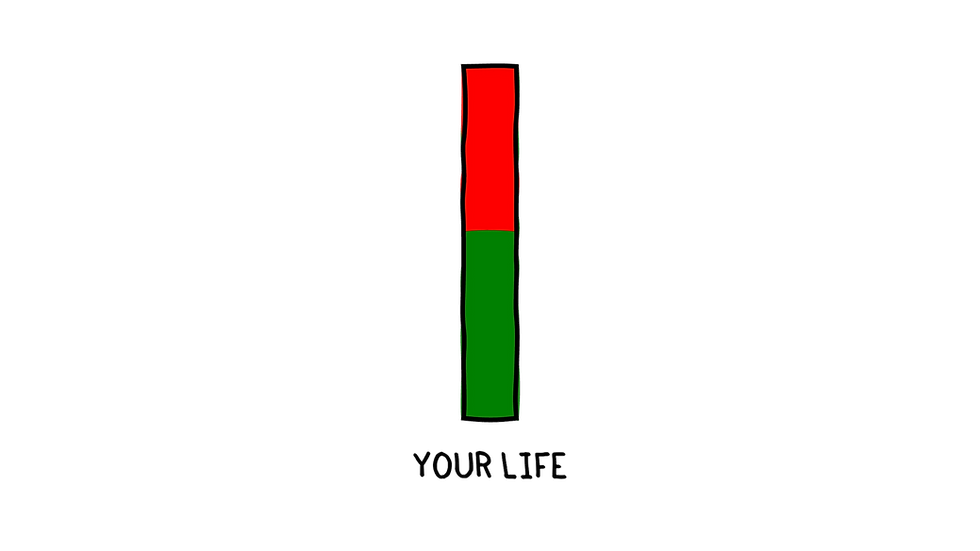
Others' lives have positive and negative parts too.

But people don't broadcast the negative aspects of their lives. They don't post the hard days on social media. So from the outside, it looks like they have it together.

Which means we end up comparing our full, unedited life to a curated version of theirs.

And since they seem to have it figured out, it's natural to want to do what they're doing.

But here's the part nobody talks about: they're doing the same thing. They're looking at your life, at least the curated version they can see, and start thinking they should do what you're doing.

This is René Girard's mimetic desire. We don't just copy what others do. We copy what they want. We want things not because we independently decided they were worth wanting, but because others want them. The desire is borrowed before we've even examined it.
That's exactly what The Joneses understood. The fake family wasn't selling products. They were manufacturing desire.
And what we end up with is everyone chasing everyone else's borrowed desires, ending in a downward spiral that leads to regret.

The Joneses used to be your actual neighbors. They were people whose real lives you had some genuine information about. Now they're a curated highlight reel from millions of people you'll never meet. The comparison was always unfair. Social media made it global.

|
 |
A grateful person exhibits certain traits. Rather than feeling deprived in life, a grateful person experiences a sense of abundance. A grateful person acknowledges the contributions of others to his/her success and well-being, appreciates life's simple pleasures, and acknowledges the importance of experiencing and expressing gratitude. |
 |
|
CHOOSE YOUR COMPARISON INTENTIONALLY
The antidote is to be more intentional about our comparisons. It's to choose your benchmark deliberately rather than letting it be chosen for you.
Compare yourself to who you were yesterday rather than who someone else is today. A gratitude practice helps; it gives you accurate information about where you actually are before you decide where you want to go.

And before you commit to a goal, purchase, or lifestyle, ask yourself if you would want this if nobody else wanted it? Would I still want it if I couldn't tell anyone I had it?
If the honest answer is no, you might be chasing a borrowed desire rather than your own.

It can be tough to ignore the pull of social comparison but the upside is higher life satisfaction and living a life that you'd be proud to look back on when you reach the end of your life.
The Joneses used to live next door. Now they live in your phone.
You get one life; live intentionally.
Interested in more like this? Subscribe and get updates sent directly to you.
If you know someone else who would benefit from reading this, please share it with them. Spread the word, if you think there's a word to spread.
To share via text, social media, or email, simply copy and paste the following link:
REFERENCES AND INFLUENCES
Ariely, Dan & Jeff Kreisler: Dollars and Sense
Burkeman, Oliver: Four Thousand Weeks
Emmons, Robert: THANKS!
Gilbert, Daniel: Stumbling on Happiness
Hagen, Derek: Your Money, Your Values, and Your Life
Haidt, Jonathan: The Happiness Hypothesis
Hanson, Rick: Hardwiring Happiness
Housel, Morgan: Same as Ever
Kahneman, Daniel: Thinking Fast and Slow
Manson, Mark: The Subtle Art of Not Giving a Fuck
Newcomb, Sarah: Loaded
Robin, Vicki: Your Money or Your Life
Vedantam, Shankar: The Hidden Brain
Wallace, David Foster: This is Water


