


LIVING A LIFE WELL LIVED


❝I can't believe that we would lie in our graves wondering if we had spent our living days well.❞ -DMB, "Lie in Our Graves"
The deathbed is a terrible time to do life planning.
A LIFE WELL LIVED IS RETROSPECTIVE
We get one shot at this. And a life well lived is the story we tell ourselves when we look back on it, whether we feel satisfied, whether we feel we lived as we actually wanted to live.
Most people don't think deliberately about that story until it's too late to change it. But there's another way. Hearing what other people wished they had done differently, especially people at the very end of their lives, can help us write a better story while there's still time.
AUTOPILOT VS. INTENTION
The default mode for most people is autopilot. Not in a dramatic way; just in the ordinary, unremarkable way that most days go by without much examination. We reach for the chips, turn on something to watch, let the afternoon disappear. No single one of those moments is a problem. But they compound. Small unconscious choices, repeated across years, add up to a life, and at the end of it, that accumulation is what you're looking back on.

The alternative is intention. Not in a rigid, optimized way; just knowing what you're doing and why. Meditation teacher Joseph Goldstein instructs people to breathe and know that they're breathing. To sit and know that they're sitting. The practice isn't about controlling the breath. It's about being present for it.
The same principle applies to the rest of life.
Walk your dog and know that you're walking your dog. Make a purchase and know that you're making a purchase. Make a decision and know that you're making a decision.
That gap between impulse and action, however small, is where a life well lived gets built or missed.

REGRETS OF THE DYING
Bronnie Ware worked as an end-of-life caregiver and spent years talking to people in the final weeks of their lives, asking what they wished they had done differently. The answers varied, but patterns emerged. She wrote about them in a blog post that eventually became a book: The Top Five Regrets of the Dying.
The five regrets are:
I wish I'd had the courage to live a life true to myself, not the life others expected of me.
I wish I hadn't worked so hard.
I wish I'd had the courage to express my feelings.
I wish I'd stayed in touch with my friends.
I wish I'd let myself be happier.
The interesting thing about this list isn't any single regret. It's the pattern underneath them. Almost every one is about permission. Permission to be yourself, to slow down, to feel things, to prioritize people, to enjoy your own life. These aren't failures of ambition or intelligence. They're failures of awareness.

|
 |
The Three-Dimensional Meaning in Life Scale assesses three dimensions of meaning in life: coherence, purpose, and significance. Coherence is the feeling that your life makes sense. Purpose is having direction in life. Significance is the belief that your life has value. |
 |
|
INSIGHTS FROM FUTURE YOU
The people Bronnie Ware was talking to had arrived at the end of their lives with remarkable clarity. They knew exactly what mattered. They knew exactly what they'd gotten wrong.
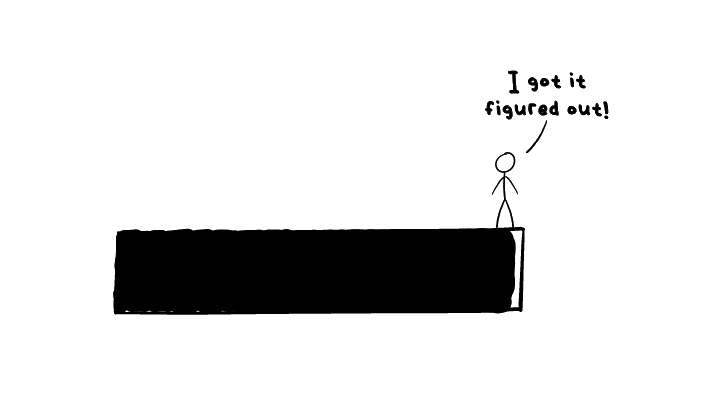
The problem was timing.

This is what Ware was pointing at. The deathbed version of you has perfect clarity and zero runway. But that version of you doesn't deserve more weight than the version of you reading this right now... the one who still has time.
The regrets aren't a warning from the grave. They're a message from a future self, delivered early enough to do something about.

AIMING FOR A LIFE WELL LIVED ACTS AS A GUIDE
Understanding potential future regrets helps us design a life worth living. But knowing what we don't want is only half the work.
It's relatively easy to articulate what we want to avoid. The harder question is what we actually want instead.
You get one life; live intentionally.
Interested in more like this? Subscribe and get updates sent directly to you.
If you know someone else who would benefit from reading this, please share it with them. Spread the word, if you think there's a word to spread.
To share via text, social media, or email, simply copy and paste the following link:
REFERENCES AND INFLUENCES
Adams, Scott: How to Fail at Almost Everything and Still Win Big
Barker, Dan: Life Driven Purpose
Baumeister, Roy: Meanings in Life
Ben-Shahar, Tal: Happier
Brooks, Arthur: From Strength to Strength
Burkeman, Oliver: Four Thousand Weeks
Burkeman, Oliver: The Antidote
Crosby, Daniel: The Soul of Wealth
Ellis, Linda: "The Dash"
Frankl, Viktor: Man’s Search for Meaning
Gilbert, Daniel: Stumbling on Happiness
Hagen, Derek: Your Money, Your Values, and Your Life
Haidt, Jonathan: The Happiness Hypothesis
Hanh, Thich Nhat: You Are Here
Hanson, Rick: Hardwiring Happiness
Irvine, William: Guide to the Good Life
Lukas, Elisabeth & Bianca Hirsch: Meaningful Living
Manson, Mark: The Subtle Art of Not Giving a Fuck
McKay, Matthew, John Forsyth, and Georg Eifert: Your Life on Purpose
McKeown, Greg: Essentialism
Pausch, Randy: The Last Lecture
Perkins, Bill: Die With Zero
Robin, Vicki: Your Money or Your Life
Sivers, Derek: How to Live
Vos, Joel: Meaning in Life
Wallace, David Foster: This is Water
Ware, Bronnie: The Top Five Regrets of the Dying


