


REFRAMING PROCRASTINATION

❝Procrastination is like a credit card: it's a lot of fun until you get the bill.❞ -Tim Urban
Most procrastination isn't a lack of motivation. It's a sign that something important is pulling in two directions.
WHY PROCRASTINATION FEELS SO FRUSTRATING
Most of us have had the same thought at some point:
I know what I should do… so why don’t I just do it?
Maybe it’s saving more. Or exercising. Or making a decision you’ve been putting off.
If you're interested in values-based financial planning, here's how to work with a Money Quotient-trained financial life planner.
From the outside, it looks like procrastination. From the inside, it feels confusing and frustrating. And over time, it can start to feel personal—like a character flaw.
But procrastination isn’t laziness. And it’s not a lack of discipline.
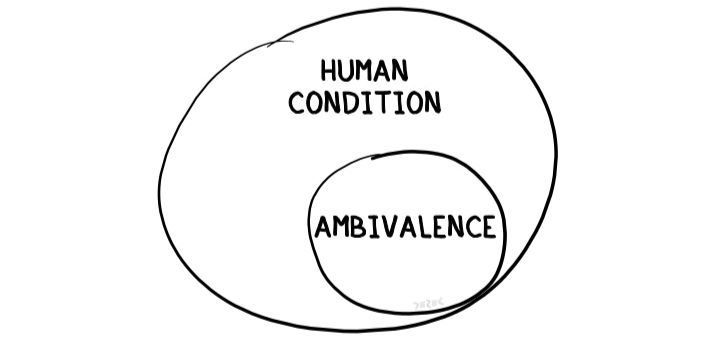
It’s usually a sign of ambivalence.
WHAT'S REALLY HAPPENING WHEN YOU PROCRASTINATE
When we don’t have language for ambivalence, we tend to imagine procrastination as a barrier.
There’s you, there’s what you want, and something called procrastination is standing in the way.

But that picture isn’t quite right. Procrastination isn’t a wall. It’s a tug-of-war.
It shows up when two motivations are present at the same time.
You want to save money and enjoy life now.
You want to exercise and rest.
You want change and comfort.
Both sides make sense. Neither is wrong. Procrastination often means something important exists on both sides of the decision.

|
 |
The Three-Dimension Meaning in Life Scale assesses three dimensions of meaning in life: coherence, purpose, and significance. Coherence is the feeling that your life makes sense. Purpose is having direction in life. Significance is the belief that your life has value. |
 |
|
WHY PUSHING YOURSELF USUALLY BACKFIRES
When procrastination shows up, many of us respond the same way:
We push harder.
We criticize ourselves.
We tell ourselves to “just do it.”
But pressure tends to increase resistance.
When part of you wants change and part of you wants safety, yelling at yourself usually strengthens the side that’s trying to protect you.
We think shame will motivate us, but it doesn't. It creates defensiveness.
The part of you that resists change is rarely trying to sabotage you. More often, it’s trying to protect something you care about.

A BETTER APPROACH: GET CURIOUS ABOUT THE PULL
Instead of asking, “Why can’t I just do this?” Try asking, “What’s pulling me in the other direction?”
You might explore questions like:
What do I want if I don’t change?
What do I want if I do?
What is each side trying to protect?
What value is underneath the hesitation?
You’re not trying to eliminate one side. You’re trying to understand both.
When you slow down and listen to yourself, clarity often starts to emerge.

HOW MOTIVATION ACTUALLY SHOWS UP
Motivation doesn’t come from force. It comes from clarity.
When you understand what matters on both sides of a decision, the tension often softens. One direction may start to feel more aligned, not because you talked yourself into it, but because it fits who you are.
Motivation follows meaning. It doesn’t precede it. And when motivation does show up, it tends to feel quieter and steadier than willpower.
If you’ve been stuck, it doesn’t mean something is wrong with you.
Ambivalence is human.
Procrastination is information.
Movement doesn’t require perfection.
When you stop fighting yourself and start listening, even small steps become possible.
And often, that’s enough to get things moving again.
You get one life; live intentionally.
Interested in more like this? Subscribe and get updates sent directly to you.
If you know someone else who would benefit from reading this, please share it with them. Spread the word, if you think there's a word to spread.
To share via text, social media, or email, simply copy and paste the following link:
REFERENCES AND INFLUENCES
Adams, Scott: How to Fail at Almost Everything and Still Win Big
Burkeman, Oliver: Four Thousand Weeks
Clear, James: Atomic Habits
Fogg, B.J.: Tiny Habits
Lindsay, James: Life in Light of Death
Manson, Mark: The Subtle Art of Not Giving a F*ck
Miller, William: On Second Thought
Miller, William & Stephen Rollnick: Motivational Interviewing
PositivePsychology.com: Motivation & Goal Achievement Masterclass
Solved Podcast with Mark Manson: Procrastination, Solved
Urban, Tim: Inside the Mind of a Master Procrastinator
Urban, Tim: Why Procrastinators Procrastinate


